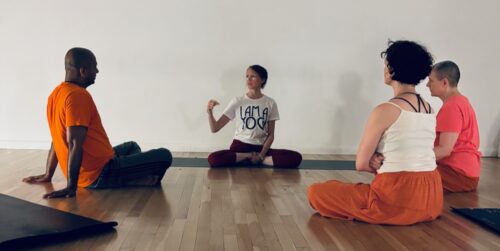
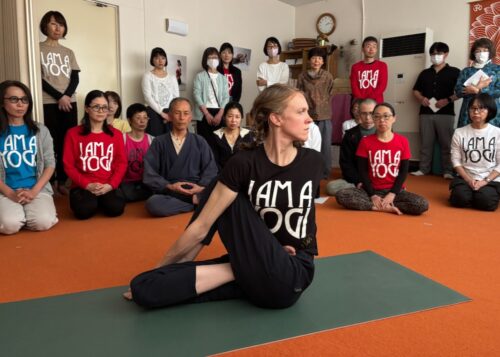
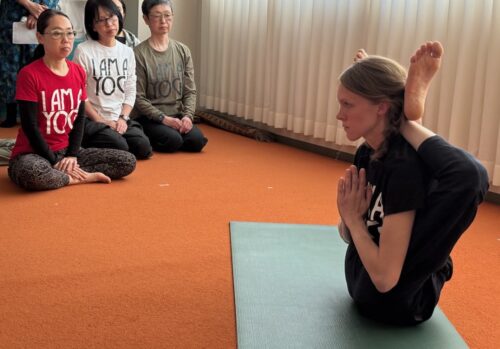
Echo From The Cave: 229

Sunday August 30th, 2026
The Typewriter Experiment at Washington Square Park
and
My Experience of Sharing the Teachings Through a Typewriter

Amid the hustle and bustle of the modern city, the most basic questions can still arise:
What are we living for? What is the meaning of life?

*

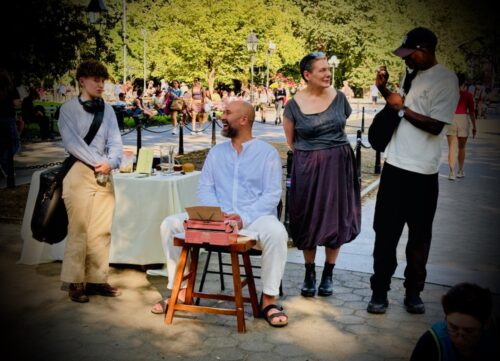
Last month in New York City, the wildfire smoke that had blanketed the city from the north cleared and two disciples of Shri Mahayogi went to Washington Square Park to try a new experiment in bringing the Master’s teachings of Truth to the public on two summer afternoons.

As the sunlight came through the leaves of the trees and flocks of pigeons swooped overhead, an old bright pink manual typewriter and a table of Mahayogi Yoga Mission publications was set up. Our brother Moksha, dressed in white, sat before the antiquated machine and began to carefully type words of our Master from The Universal Gospel of Yoga. Meanwhile, his sister in Yoga—myself, Prajna—assisted by waiting at the table and watching the passersby, ready to share Shri Mahayogi’s words with anyone who expressed an interest in them. Each time a page became full of the typed-out teachings, each individual saying was cut and placed in a glass vessel to be taken by anyone who wanted to receive it.

For several hours each day, many people flowed past, some involved in conversation with their friends, others looking at their phones or glancing over at the typewriter before hurrying by. But there were some people who seemed to be intrigued by the beautiful book covers and by the sight and sound of the old-fashioned instrument, click clacking away, with its bright bell ringing cheerfully at the end of every line.

In presenting the teachings of Yoga in that setting, one of the challenges was to find a way to spark curiosity about why we were there and what we were doing, and another was to be able to speak about Yoga no matter who approached us and what they might ask, think or believe.

The typewriter created that interest by providing a sharp contrast to the fast-paced way of today where instant gratification is the norm. The physical nature of its operation subtly changed the atmosphere around us, visually separating us from the other activities that were going on. There were some children who were absolutely fascinated by it, having never seen or maybe even heard of a typewriter before. There was an intriguing performance aspect to it all that had nothing to do with making a transaction like trying to sell a book or anything like that; we were simply there to try to present Yoga as Shri Mahayogi has brought it to us and as something that is valuable for everyone.

Having said that, actually, using the typewriter in and of itself turned out to carry a symbolic message, though it was only by us actually putting the typewriter into action that Moksha and I gradually began to recognize that. Perhaps we have forgotten the way we once used to do things, but typing on the typewriter takes a lot of concentration, because if we make a mistake, we can’t just make it all disappear with the stroke of a key. It forces us to slow down our fingers and to slow down and focus our minds on the task at hand. And importantly, it seemed that the deliberate force that we needed to apply to type each and every letter was as if it was helping us to slowly imprint the meaning of the teachings on our minds more and more, and then further—and perhaps most importantly—to think about what those words mean, what is being said beyond the literal meaning of the words… It seemed to remind us that perhaps by concentrating, by the experience of using the body and repeating the same action—things that both typing and asana may have in common—profound changes may begin to take root over time. Even though our experience of this typewriter project may only be beginning, in a way, it seems as if it is only through doing it and putting ourselves into action that we are able to glimpse and start to learn these things. 

Through Doing, We Are Learning—Sharing the Words of Truth

“The various appearances of this world are always changing and vanishing, but the essence of this world is Eternal.”    —Satguru Shri Mahayogi Paramahansa

This is one of the sayings from The Universal Gospel of Yoga that Moksha selected to be typed. Indeed, at the heart of this project is our wish to share Shri Mahayogi’s teachings of Yoga that we feel are truly so valuable. And prior to going to the park, our sister, Karuna, and I had compiled various teachings, thinking they might be good to offer to people who may not have any familiarity with Yoga. But actually, the words above chosen by Moksha, and many of the sayings he chose, offered a different perspective compared to the ones we had compiled. The approach in his choices seemed to give people space to think. I hadn’t thought about it this way until I saw it, but perhaps encountering this teaching unexpectedly could open the door to Yoga for someone who may only have been exposed to a form of asana, or even to someone who has never heard the word Yoga before at all.

Choosing and sharing the actual words of Shri Mahayogi is one thing, but then communicating with people beyond the words written on the paper, that is another important part of this project and one I found myself most challenged by.

Actually, on the first day, I was very nervous on the way to the park and had to continually bring my mind back to Shri Mahayogi and the reason we wanted to try this: to share his Existence and teachings with whoever showed an interest.

To be completely honest, sharing Yoga with others has always been very challenging for me. I’m not necessarily confident about my understanding—even though on some level I can recognize how valuable and precious the teachings are, I’ve been having trouble grasping what the main point of a teaching is, seeing the whole rather than the parts, and I seem to make the teachings conform to what my mind already believes without even realizing it, rather than bringing my mind toward the teachings. And on top of that, I tend to become concerned about what others may think about me. Stepping into the park, was like putting myself in a position where I would be forced to set all this self-concern and doubt to the side and bring my focus to the people in front of me rather than myself.

Seeing Moksha and his way of being became a great example for me. His face beamed with enthusiasm when he spoke about Yoga and Shri Mahayogi, and his way of quietly considering the words of the people he talked to, and responding thoughtfully and carefully to each one, was very inspiring and instructive. There was no sense that he was trying to or needed to teach something, but rather to share something truly precious and valuable in words that could be understood by anyone.

We spoke with a variety of people, and as it turns out, some had a familiarity with Yoga and some did not. Some wanted to ask questions about how we had encountered Yoga, what our lives were before Yoga, or were curious about Shri Mahayogi’s life and Satori. Others were more interested in telling us their own stories and their connections to religion or spirituality. One gentleman wearing pink heart-shaped glasses bought a copy of The Universal Gospel of Yoga. Others expressed interest and took flyers for the online and in-person Asana and Meditation classes. Still others took a teaching with them as they went about their business with just a simple thank you.

All of this helped me see that it was important for me to be open to whatever people wanted to talk about, and to be approachable. It seemed best to be as simple, calm and receptive as possible. Our sister Anandamali, a senior gurubai, has often stressed to us the importance of focusing on the people in front of us and meeting them wherever they are; this experiment ended up presenting a great opportunity for me to work on that, to focus on others rather than myself, to concentrate on listening rather than planning to speak, and to learn to respond “guilelessly and honestly,” according to Shri Mahayogi’s words.

When I reflect on this project now and think about the experience, I see that indeed, there were many things about this experiment that I really didn’t expect; actually doing it was completely different than what I imagined during the planning, and it was important to let go of whatever imaginary scenarios I might have had in my mind. That makes me want to work towards letting my mind become more and more open to putting myself into action without having certain expectations or worries about the results, and through that also become more and more open to what Shri Mahayogi is trying to show me.

What are we living for? What is the meaning of life?

Before encountering Yoga, I, myself, had these questions and it wasn’t clear to me that there even could be a definite answer. And it was not until experiencing a string of heartbreaks, losing some of the people I cared the most about, that I started to take these questions more seriously and turn towards Shri Mahayogi’s teachings. Even though my understanding was remaining on the surface, such that I couldn’t really apply much or experience their deeper meaning, I can certainly recognize some changes in myself that I believe definitely would never have come without bringing my mind to think more about Yoga and the Master.

I am grateful to Shri Mahayogi for his Existence, for the teachings he imparted, for allowing me to start to come closer to those teachings, and now, for this blessed opportunity to share the Truth! I look forward to continuing to learn more and to develop the ability to speak about Yoga and Shri Mahayogi. Experiencing that made me understand better that no matter the situation, whether with friends or strangers, the preciousness and value of Yoga, which can improve my own life situations in ways that I’m only just beginning to comprehend, can also improve the life situations of anyone I encounter. I should therefore always be alert to the opportunities that exist all around me to share Yoga more and more, without allowing any of my own thoughts or ideas to stop me.

Thank you to the brothers and sisters of Mahayogi Yoga Mission New York, for sharing this journey!

Prajna

Afterwards, Moksha, with a press card, immediately left to see and report on the FIFA World Cup Final in New Jersey!


Echo From The Cave: 228

Monday August 24th, 2026

Training the Mind Through Asana Practice: 1

In this day and age, we are surrounded by endless sources of stimulation, and our minds and senses are constantly being exposed to and engaging with fast-moving external stimuli that keep changing forms. Our minds continuously chase after these stimuli, remaining perpetually full, or perhaps, by now, the mind may even be afraid of not turning its attention outward—frightened at the thought of getting bored and not knowing what else to do.

When we step into our Asana and Meditation class, our minds are immediately enveloped in the quietness. And when the practice begins, most of the practitioners practice the same asana in sequence in this quietness, each pose being held for a long while in this silence.

When we are just starting the practice of asana, forming the body into certain positions can be challenging, as can following the instruction of breathing. Or, perhaps it may be that forming the body into a certain position may not necessarily be that challenging, however, where the real challenge may lie, more than anywhere else, is in holding the same position for a long time—the mind is not used to being in a situation where there isn’t any extra external stimulation around to engage it, and in place of that, what is heard in this silence is the voice of our own mind, not faintly, but rather loudly. Indeed, what’s moving is not any stimulation from the outside, but our own minds. Training—this is actually where the aspect of and need for “training” comes in in the practice of asana.

Nowadays, asana practice may be treated as an exercise, but rather, in a way, it is training—training of the body, the breath and the mind—it is training for us to be able to sit steadily and comfortably in meditation, fully focused on the object of meditation with calmed breath and with silence in the mind; and in the end, it is a training through which the body, the vessel, “comes to be reborn or transformed into a yogic body or diamond body, which refers to the condition in which the ten workings of prana are controlled and stilled” (Shri Mahayogi’s words during Satsangha, Pranavadipa Vol. 118). Perhaps, it may be commonly thought that by gaining flexibility or strength we can cultivate the body and bring it to a steady and comfortable state, however, being able to sit steadily and comfortably does not depend on the condition of the physical body alone, it goes hand in hand with a mind that is steady and at ease.

It is good to remember that asana was originally intended for meditation, and the reason why we practice is for that purpose. Even if you may not practice asana for meditation, perhaps you have felt the peace within that practicing asana brings, and that that is a great gift that can reset our minds instantaneously no matter what we go through during the day. That itself is already a great benefit, indeed, yet, it doesn’t necessarily mean that that peace in the mind will last; “Sit steadily and comfortably in meditation”—even if we are able to sit and be steady and comfortable, physically speaking, it doesn’t mean that our minds are not still loud and restless. That’s why in asana, it’s important to focus on the breath, because that is where there is a key for the mind. In life, we experience that when the mind is going up and down, as if it were on a roller coaster, our breath is irregular, however when the mind is calm and steady, our breath is similarly calm. Yogi discovered the link between the mind and the breath—the breath follows the state of the mind—so if we work from the reverse direction, we can calm the breath, and then the mind will follow accordingly. Still, even so, it doesn’t automatically mean that we will achieve peace within or quietness of the mind. In order to gain that stability and quietness of the mind, something more must be integrated into the practice—the aspect of training itself—and it’s important to remember that asana practice is a training.

When training, you do the same things over and over—this is a basic step for when we learn or practice to master any skill. In this digital age, it feels as if our minds have lost being patient, craving only quick results and mistakenly thinking that we’ve truly learned, all the while leaving behind the importance of the process that goes into it. But again, it is good to keep in mind that when learning to play the piano, you play the same part again and again until you master it. When you go to piano lessons, the teacher may correct you or show you how to play, and then you practice that at home. Then when you go to the next lesson, you play the same piece of music, which should now reflect what you were corrected on and what you learned from the piano teacher the last time. In the same way, when we come to the Asana and Meditation class, we practice the same asana, and our practice in each class should reflect what was learned during the last class. In between classes, that is where daily practice comes in in order to master what we are being taught; to master means to have it become our natural state without needing to make any intention about it.

Doing the same thing over and over—there are different benefits that this can bring to us, one of which is psychological. Every day the condition of our minds and bodies are changing, they don’t stay the same. Naturally, life brings many events and happenings. Affected by these outside conditions, some days the mind feels heavier or the body feels stiffer than other days. But by patient repetition of the same training, we can develop inner strength and stability of mind no matter what the conditions may be. And today, as we are living in this digital age where there is frequent discussion about how the internet has shortened our attention spans, this way of practice—training—may be more important than ever before. Sometimes, we need to swim against the current. And that current is not only what’s happening in the outer world, but it can also be what’s happening in our inner world too, where perhaps it is even more strong than the outer world. The voice that says, “I’m bored of doing the same thing again and again,” or the voice that says, “I’m too tired today, so I better not do it,” or, “I feel this or that way, so I better take it easy”—these are the voices that reflect that current within our inner world. Indeed, that kind of habit has practically become second nature.

And right there, with habit itself, is where another benefit of doing the same thing over and over comes in. We learn that our mind is habitual, it has a habitual nature, and thus that means that the tendencies of the mind, which arise from the habits we continue over a long period of time, actually can be changed. That being said, however, probably we all have experienced that the mind is prone to simply following its own habits or easily slips into old habits and tendencies even when we try to fight against them. When that happens as we go about our daily life activities, it might not be that easy to catch. Interestingly though, this aspect of how the mind follows or slips back into its own habits is something that also appears symbolically within the asana practice of each individual, thus the aspect of doing the same thing again and again becomes ever more important and relevant, because the practice of asana can become the ground for training in new habits and gaining strength in repeatedly facing and going against those old habits and tendencies so that they can be changed once and for all. Though, it goes without saying that this all depends on the clearness of our aim and the strength of will we have to transform our own selves.

The other day, all of the class attendees were regular attendees and gurubai, so at the end of the class, Sadhya, who was leading the class, asked them to reflect on the feedback they had each received during the class. Rather than allowing the mind to take the feedback as a momentary suggestion, remembering it so that it could be solidified and clarified in order to apply it not only in daily asana practice at home and before the next week’s class, but also in working to improve oneself in daily life, would make that feedback meaningful. By everyone having the opportunity to hear the feedback, each one could take it into consideration for their own situation, even if they were not the one receiving it directly.

Mr. D began to excitedly speak about how he had been introduced to a new asana called chakrasana (the wheel) and that he really enjoyed practicing it, expressing his intention to try it at home. In that moment, Anandamali, a senior disciple who was observing each participant’s practice during the class, knowing that Mr. D does not necessarily practice asana at home, mentioned to him that chakrasana is a very intense pose and not one that can easily be practiced in isolation, especially when one first begins to practice it, as it needs the preparation of the asana that come before it to ready the body and mind, therefore he should make sure to practice all the other poses before that and not the new, exciting asana alone. By saying that, she gently directed him back toward daily practice, and Mr. D smiled in response.

It’s an important message for all of us, isn’t it? Especially for the time in which we are living, where the “new and exciting” is always given priority over whatever is regular, repeated, disciplined, a mixture of things we may like or not like, and in the category of what we think we “already know.” It is the same current mentioned before that is happening just as much in our internal world as in the world around us.

After hearing it, Sadhya reminded Mr. D of another important piece of feedback he received from Anandamali during the class. It came during bhujangasana (the cobra), when he was asked by Anandamali to come down and try again, this time without rushing and consciously raising vertebra by vertebra. This slowing ourselves down and making time and space to be conscious of what we are doing, and that we are doing it according to how it is being taught, is certainly an important training in the practice of asana and is something quite practical that we can apply at any moment in our daily lives. How often are we rushing around in this fast-paced world where the expectation of everything being instant is dominating? To slow down and be conscious of what we are doing, what we are saying, and why; in taking time to think, to notice subtle differences and how that affects what we are doing and the outcome, rather than just producing a haphazard result for the sake of producing a result—there is a lot of space there where our minds can learn and open up to new things, observe things about ourselves and keep seeing things that we can improve.

Another practitioner, Ms. K, began to say that during the class, while working on practicing poorna dhanurasana (the complete bow pose), as she was trying to enter the pose starting from the opposite side of the body than what she was accustomed to, she expressed to Anandamali, who was observing her practice in that moment, that because it was so out of the norm, it felt as if she didn’t know how to move her body, which made her mind become blank, and she just couldn’t seem to do it. In that moment, Anandamali mentioned to her that she already knows how to move the body when starting from the other side, so rather than not knowing how to move, it’s simply that this side is a little less flexible than the other side, which is normal; and also, knowing some of the struggles Ms. K has faced, said that it is actually symbolic of how Ms. K’s mind goes blank when faced with something that is challenging for her in daily life—the mind becomes blank and then uses that state to avoid having to face and do something it’s not used to doing or doesn’t know how to do. By mentioning it, Anandamali helped her recognize that the mechanism of the mind that sets itself into motion when facing challenges in daily life, is exactly the same mechanism that was appearing when facing this challenge in asana, albeit in a smaller, more simplified version. After starting to see it and after calming her mind, she was able to do the pose starting from that side—perhaps not as deeply, but she was able to do it.

Our mind follows along no matter where we go or what we are doing, and that means so do all of its habits and tendencies. Sometimes what we can’t see or recognize is happening within us during daily life appears in a simpler, more recognizable version during the asana practice, when there’s less going on around us to conceal it from our view. Right there, when those habits of our mind appear, we have the chance to see that appearance as an opportunity to overcome whatever story the mind is presenting to us as if it were in some sense “the facts,” and repeatedly put it to the test. The habits in our minds must certainly be wrapped around certain beliefs that the mind is clinging onto—in a way, those beliefs that are intertwined with our habits are what our minds often present to us as “fact.”

Beliefs are not commonly something that the mind will easily let go of, because, in a way, by clinging to beliefs it’s as if the mind feels it has some steady ground to stand on, and through the repetition of habits, those beliefs seem to become more and more solidified, and what are merely our habits come to seem as if they are our very way of being—unchangeable and a matter of fact when looked at from the mind’s view. Because our minds, in one way or another, always seek something to rely on, we easily become dependent and then rely on our habits with the various beliefs intertwined underneath. Yet, because the belief, which often is not based on the Truth, but rather the incorrect or limited thinking of our minds, has to be constantly sustained and reinforced through our habits, an endless stream of thoughts, concerns and activities of the mind sprout up one after another to serve that purpose, filling the mind with constant activity. For this reason, the habits of our mind rarely change for good quickly, and that’s exactly why continuous and repeated training is so important. Through taking the opportunity of facing the same asana again and again, the mind gradually can come to learn through experiencing the repetition of going against that simplified version of our habit that appears in asana that the habit it has relied on is actually unnecessary, and as a result, the mind’s grip on the belief intertwined with it will loosen and eventually let go, sometimes without even necessarily being conscious of it.

Another practitioner in attendance was Ms. P. Ms. P has been having very shallow, loud and rapid inhalation immediately upon releasing some asana, while resting in savasana. Ms. P said that, during the class, Anandamali mentioned to her that it seemed that she was focusing on inhalation in asana instead of concentrating on exhalation, so her focus needed to shift to the opposite, to exhalation. Ms. P expressed that she was surprised to hear it, since she had thought she was following the instruction for breathing, but she felt that “shift” is a key for something she has been struggling to figure out, which is how she can work on her way of approaching things in daily life. Though not quite clear on what that should look like yet, she wanted to keep thinking about it and trying to recognize for herself what that shift to the opposite would look like for her, practically speaking.

To shift—it’s an act that is quite symbolic. In our asana practice, while holding the poses we practice making each exhalation long and complete and letting the inhalation be natural. When just starting to practice asana, focusing on the exhalation may feel rather new because this is almost the opposite of what we normally do and are taught in life—for example, “take deep breaths,” or “it’s important to breathe in more.” When just beginning to practice, because various poses might be physically challenging, breathing in savasana might become more rapid or heavier after releasing, but after years of practice, the long and complete exhalation from the abdomen becomes the more natural way of breathing during asana, and even though we may continue to work on extending the exhalation and making it more complete, whether intentional or not, it can also be said that it is as if the base of breathing changes from inhalation to exhalation, meaning that, for the mind and body, the inhalation comes to be a natural reaction to exhalation, serving the purpose of aiding the exhalation in being long and complete. Then it can be said that the state of quietness of the mind and breath that arises from that continues in savasana, in meditation, and also in daily life.

In a way it seems that all of this focus on exhalation, including many things that can be said to relate to that, evokes the great metaphor expressed in one of the verses of the Bhagavad Gita (2:69): “Where it is dark night for the [sense-bound] world, the self-controlled [man] is awake. It is daylight for him. … And where the world is awake, the sage sleeps.”[1] As it indicates in this verse, shifting does not necessarily mean a shift of the surface action alone, but it is rather a shift that ultimately needs to take root in the very fundamental ways of our being, including our way of viewing, thinking and subsequently acting—and that means that there is even a reversal or turning upside down of the subtle aspects or subconscious workings of the mind that are at the base of our way of viewing, thinking and acting within this world.

The whole of Yoga has this very shift at its core, and the practice of asana, along with its aspect of training, are of no exception.

[1] As spoken by Swami Vivekananda in a lecture on the Bhagavad Gita in San Francisco, 1900. This verse (2:69) is commonly translated elsewhere as: “That which is night to all beings, in that the self-controlled man keeps awake; where all beings are awake, that is the night for the Sage who sees.”

Come and join us!

Echo From The Cave: 227

Friday August 14th, 2026

Drawing Inspiration From Brother and Sister Disciples
Who Are
Striving to Draw Closer to the Teachings of Yoga

Since my earliest memories, I remember having the tendency of becoming frustrated when I didn’t understand something. Not only that, my mind is always seeking for a quick answer, and the understanding has to be of the nature that I don’t have to revisit or think about it anymore. I’m also usually satisfied with an intellectual understanding and don’t make an effort to go through a process of discovery on my own. Probably, this has to do with my habit of tending to lose patience and give up quickly if I encounter something that I need to struggle with, or something that needs a lot of effort or might take a long time to learn or understand.

In May, Sadhya, our sister disciple in New York, did an asana demonstration, followed by Question & Answer, in Matsuyama, Japan, and the questions and answers were published in Pranavadipa Vol. 139 (Mahayogi Yoga Mission of New York’s monthly online publication).

Watching Sadhya practicing asana in the past, I’ve noticed her strong concentration, but I was sure there must be something more than that. As I read the questions and answers, I became excited because I thought I could get a glimpse into Sadhya’s inner world during her practice of asana, but I also sensed a feeling of frustration starting to build slowly within me as I was reading, which manifested itself in me reading these questions and answers faster and faster. After I finished reading, I was left with the uplifting feeling that came from sensing Sadhya’s effort and determination to deepen her practice, but I also saw a part of my mind being disappointed because I didn’t get a definite answer to what Sadhya’s experience was, or what she has realized during her asana practice.

For example, in our practice of asana, while in most of the asana, the eye gaze should be pointed toward a certain direction; so when she was asked what she was seeing when her eyes gazed during an asana, she answered that she was not really seeing anything. Or when asked if her internal concentration happened naturally or if it started to happen gradually, her answer was that she doesn’t know exactly because she was not necessarily aware of it.

Another instruction during the practice of asana is to focus on the exhalation. Sadhya was following the instruction wholeheartedly, but again, in her answer, there was no mention of any experience as a result of her concentration, but rather, her answer was “even something as simple as the breath, the focus on the breath, I feel, is an internal focus.”

After reading through the Question & Answer a couple of times and looking more closely into Sadhya’s answers, even though my mind wasn’t getting the kind of answers it was looking for, I sensed that despite the fact that her concentration was intense during the asana, there was a kind of freedom in her practice.

Then I noticed that her answers were hinting towards the idea that an experience can be a result of a long process we put ourselves through, and not necessarily from a quick act with a certain result that the mind chases and expects while going through that process. And actually, the holding of a certain image of what the result should be seems to be blocking me, and probably many of us, from letting the real experience take place instead.

While reading, my mind was in a state of being tight or bound to an expectation or an idea, whereas her answers were pointing to the exact opposite: a mind that does not chase a certain result is free, or at ease, always ready to be used for the next step in the process. As I read, I looked back at my asana practice when I used to do it, and then, when comparing to her mind, I realized that my mind was in the exact opposite state. And, I saw that I read to try to get an answer quickly, instead of simply letting myself be inspired by her practice and the unknown that can possibly come at some point as a result of applying the same hard work and dedication; I also saw that, in this state, my concentration is weak and the mind is not at ease.

It seems that for any achievement one strives towards, what’s needed is a certain amount of passion, dedication and hard work, and the mind is definitely needed there as a tool. At some point, going against the habits of one’s own mind, which aren’t necessarily helping in the process, and at the same time building new positive habits, are things that also seem indispensable, especially when we are aiming for that which we’ve never experienced before. If the aim is the transformation of one’s own self, these qualities are even more urgent.

In today’s world, where we can get answers instantly to almost anything through the use of the internet, the tendency is to think that we know or we understand, and this can give our minds a quick feeling of satisfaction. But the danger is that, usually, in this case, the mind can only get an intellectual idea about the subject, and not have a deeper understanding based on an actual experience. And when we are put in the situation of having to practically explain or use our understanding in the real world, we almost always fall short and feel lost.

For me, one of the most intriguing things that Sadhya said a few times when answering was that she is trying to get “closer and closer.” Her words seem to indicate that she leaves herself open to the unknown, because presumably she tries to get close to a state of being, an experience that she has not experienced yet. It portrays and hints at an internal journey that no one can truly understand just by hearing or seeing the person who is experiencing it. How often can we truly say that we understood somebody else’s experience without having lived through it ourselves? Yet, her constant inspiration is from those who have reached a state of being that is even beyond the mind.

Shri Mahayogi teaches that the state beyond the mind is the natural state of human beings, which is a state of complete peace. There are probably not many who have devoted themselves fully to reach such a state, however, it is, in a way, a journey that most likely all of us will have to take, in one way or another, if we want to transform ourselves and reach our full potential. Those who have reached that state beyond the mind throughout the ages are proof that any of us can experience that too. Having the opportunity to meet someone in that state is extremely rare, and unless receiving the guidance from someone who is already in that state, it’s impossible to reach the realm beyond the mind. Have I, or any of us realized that? Only by devoting and giving ourselves completely can we say that we have.

Shri Mahayogi says that that state is already here and now. In order for me to start walking more concretely and get close, or rather, go closer and closer to that, I must accept that there is nowhere for me to rush off to or get to. I also need to accept that what stops me from experiencing it is precisely my mind’s belief that getting a quick answer or intellectual understanding will make me happy or at ease.

At this moment, all I can say is that the teachings of Yoga—which go far beyond the asana—and the examples of my brother and sister disciples, have been my only tools. Even though I can’t say that I understand the teachings or the examples of my brothers and sisters fully, they have at least helped me pause and notice the patterns in my mind I mentioned above.

Seeing Shri Mahayogi’s teachings that Sadhya is putting into action in the practice of asana is an inspiration and also a concrete example of what I can actually work on. Clearly, first and foremost, I need to build passion, the passion that has the strength to drive my mind constantly towards the need to transform; and I believe that this passion can come by continuing to study, think about, try to understand and incorporate the teachings into my real-life situations, while at the same time, being with and finding inspiration in the examples of my brother and sister disciples. And importantly, beyond mere intellectual understanding, I have to put the teachings into actual practice in order to truly understand them; so I will practice discriminating between the content of my mind regarding myself and the outer world, and the ultimate Truth, and then relinquish my false notions that are not rooted in the ultimate Truth. This is one of the practices of Yoga. Shri Mahayogi says that this is a constant battle, but just like with Sadhya’s strong concentration in the asana practice—which stems from her determination—it is something that I must determine and dedicate myself to, making space in my mind to allow for something that I never thought of to come in, without having any specific expectations. This way, hopefully, I, too, can inspire others to connect with and learn Shri Mahayogi’s teachings of Yoga.

Shri Mahayogi, I’ve started to recognize the necessity of actual practice more concretely than before, and I am so grateful for your giving me, and all of us, the opportunity to transform ourselves through Yoga!

Ekanta

Echo From The Cave: 226

Sunday June 28th, 2026

Announcement: SAVE THE DATE!!
—Special Screening in NYC—
Satguru Shri Mahayogi Paramahansa’s Satsangha, Japan
Sun, July 12th 2026

Special screening event of the recorded footage of Satsangha (Q&A) with the Enlightened Master of Yoga, Satguru Shri Mahayogi Paramahamsa.

Description:
To sit near an Enlightened Master—since ancient times this has been one of the most revered and precious opportunities one can encounter, and for many years Satguru Shri Mahayogi Paramahansa, an Enlightened Master of Yoga, gathered closely with one small group of seekers at a time and quietly conveyed the teachings of Yoga, the teachings of the Truth.

Gathered in this intimate setting, the serene stillness of Shri Mahayogi’s presence would unfold silently into every ounce of space, the incredible lightness of his form and his compassionate smile would shine brightly, and the unshakeable Truth that he spoke would begin to dispel and clear the confusions and doubts of the mind.

In such an atmosphere, Shri Mahayogi attended to everyone present, answering their questions with great care, and ever-directing, even through some of the most common matters of daily life, to the path that can lead straight to the realization of the Truth, that which is the essence of our true nature, that which is ever-free and untouched by sorrows.

Mahayogi Yoga Mission invites you to experience with us the incredible scene this rare footage captures.

This footage will be screened twice on the day of the event. The admission ticket is all inclusive and attendees are welcome to attend one or both screenings. There will be an intermission between screenings and some time reserved after the final screening. For attendees who would like, this time may be used for further learning about Shri Mahayogi, about the teachings of Yoga, and for discussing with practitioners who have been learning Yoga under the guidance of Shri Mahayogi.

When:
Sun, July 12th 2026

Doors open 2:30 pm       
First Showing 3:00 – 4:10  
Intermission with discussion 4:10 – 4:55  
Doors Open for Second Showing Arrivals: 4:30 pm
Second Showing 5:00 – 6:10   

Location:
Near Grand Army Plaza in Park Slope, Brooklyn 11217
(Exact Address will be provided after RSVP or ticket purchase)

Registration or RSVP is required at least 24 hours in advance:
· ONLINE REGISTRATION (at least 24 hours in advance) – Click here

· RSVP to PAY AT DOOR (at least 24 hours in advance) – Click here
Note: Tickets are non-transferrable.
For cancellation or changes, please contact MYM staff – Click here

We look forward to seeing you!

Echo From The Cave: 225

Tuesday April 14th, 2026


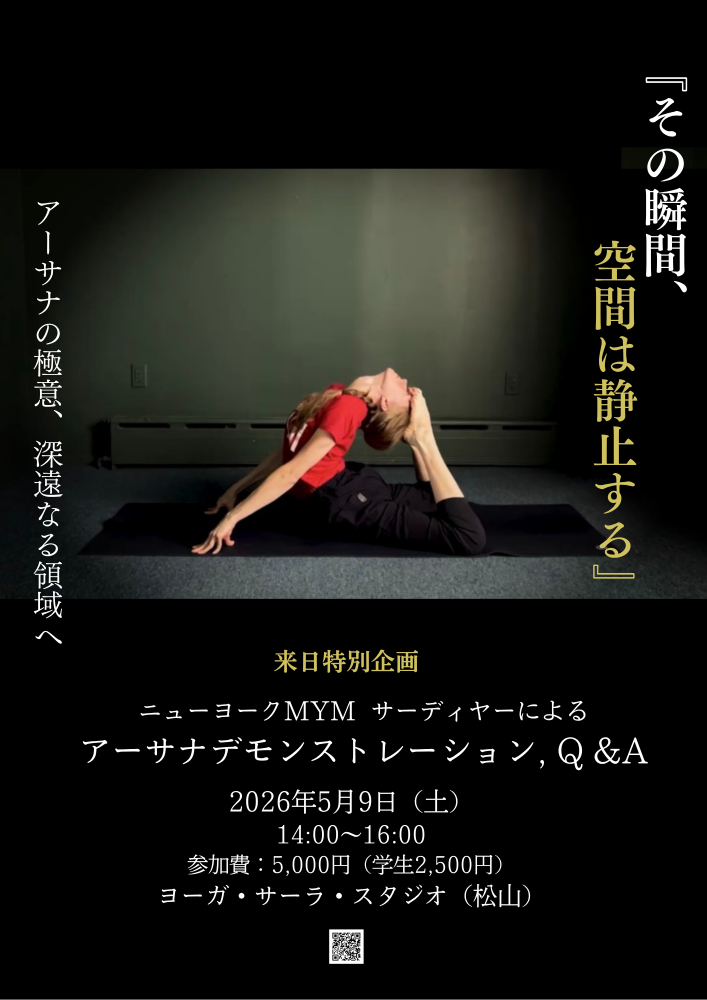
“In that moment,
the space is stilled.”

To the profound realm and the arcana of asana.

Special Event in Japan:
Asana Demonstration and Q&A by Sadhya of Mahayogi Yoga Mission New York

Saturday May 9th, 2026
14:00-16:00
At Yoga Sara Studio in Matsuyama, Japan

Her asana itself was a complete shock to me. When she began the asana, the space was immediately controlled by her prana. Regardless of the intenseness of the asana, her breath was stilled. It was a state of an extreme peak, so much that I was afraid to even breathe.
I heard that she sought God and the growth of herself, and after finding her Master, she devoted everything to her daily practice of asana.”  (2017, Kyoto, Japan)

“I felt that not only were her body and mind stilled, but the entire space was completely stilled.”
(2017, Kyoto, Japan)

“Breathtaking concentration, her stunning presence in asana suggested that there was an arcana, a profound realm to the essence of the asana that has been passed down from the Master.”
(2022, Sanatana Dharma Avatara Mela)

For inquiry; please contact here.

Echo From The Cave: 224

Wednesday April 8th, 2026

“Whenever the world is filled with unrighteousness,
and the Truth or Justice declines and is forgotten,
at that time,
I manifest myself on this earth

in order to annihilate the wicked
and to reestablish the principles of Justice (Dharma).”

These famous verses from the Bhagavad Gita (Ch 4. 7-8) , the highly revered scripture spoken by Lord Krishna, resound in our hearts following Sanatana Dharma Avatara Mela (The Grand Gathering in Celebration of the Divine Manifestations of Eternal Truth), held this year on April 5th.

These same verses have been spoken by Shri Mahayogi on various occasions, rekindling something deep within us that seems to expand our minds far beyond the bounds of our small world of this time and place, to recall and sense the grand scale and timelessness of this blessed occurrence—the appearance in this world of one who shows the way back to the Eternal Truth, the true essence of each and every one of us and of the whole of existence.

Time and time again, in each and every era, the world may indeed fall into tumult. Yet, in each and every era, that Eternal Truth, that is ever unchanging and untarnished, no matter how much it comes to be covered up with the stirrings of the world, indeed comes to be crystallized in front of our very eyes in the form of a Great Being who lives and acts among us, showing us through their pristine example the path that will not only lead each and every one of us to touch and experience that Eternal Truth firsthand, but will ultimately bring about a great benefit for all of humanity and the world.

We bow down in utmost reverence to these Great Beings—among them, Buddha, Shri Ramakrishna, Ramana Maharishi, and our beloved Guru, Shri Mahayogi—and express our most sincere gratitude.

Om Tat Sat, Om!
Om Tat Sat, Om!
Om Tat Sat, Om!

Echo From The Cave: 223

Sunday March 29th, 2026

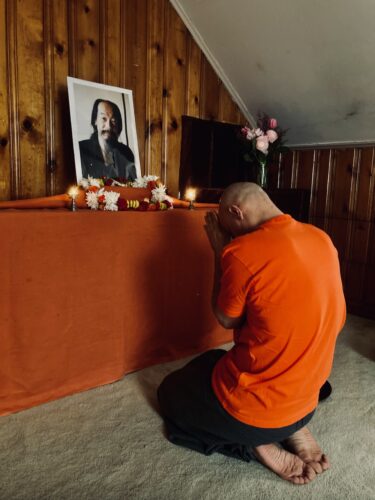
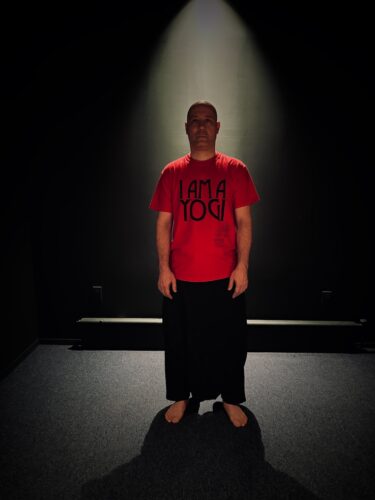
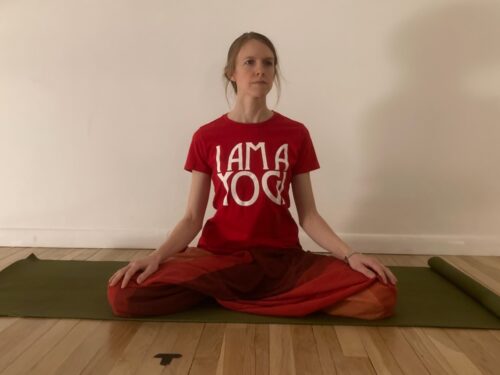
“I AM A YOGI”

Our Dearest and Most Beloved Shri Mahayogi

In celebration of the 50th Anniversary of Mahayogi Mission Japan,
the 30th Anniversary of Mahayogi Yoga Mission New York,
and the 5th Anniversary of Mahayogi Mission Taiwan

Echo From The Cave: 222

Tuesday February 24th, 2026

Announcement: SAVE THE DATE!!
—Special Screening in NYC—
Satguru Shri Mahayogi Paramahansa’s Satsangha, Japan
Sat, March 21st 2026

Special screening event of the recorded footage of Satsangha (Q&A) with the Enlightened Master of Yoga, Satguru Shri Mahayogi Paramahamsa.

Description:
To sit near an Enlightened Master—since ancient times this has been one of the most revered and precious opportunities one can encounter, and for many years Satguru Shri Mahayogi Paramahansa, an Enlightened Master of Yoga, gathered closely with one small group of seekers at a time and quietly conveyed the teachings of Yoga, the teachings of the Truth.

Gathered in this intimate setting, the serene stillness of Shri Mahayogi’s presence would unfold silently into every ounce of space, the incredible lightness of his form and his compassionate smile would shine brightly, and the unshakeable Truth that he spoke would begin to dispel and clear the confusions and doubts of the mind.

In such an atmosphere, Shri Mahayogi attended to everyone present, answering their questions with great care, and ever-directing, even through some of the most common matters of daily life, to the path that can lead straight to the realization of the Truth, that which is the essence of our true nature, that which is ever-free and untouched by sorrows.

Mahayogi Yoga Mission invites you to experience with us the incredible scene this rare footage captures.

This footage will be screened twice on the day of the event. The admission ticket is all inclusive and attendees are welcome to attend one or both screenings. There will be an intermission between screenings and some time reserved after the final screening. For attendees who would like, this time may be used for further learning about Shri Mahayogi, about the teachings of Yoga, and for discussing with practitioners who have been learning Yoga under the guidance of Shri Mahayogi.

When:
Sat, March 21st 2026

Doors open 2:30 pm       
First Showing 3:00 – 4:10  
Intermission with discussion 4:10 – 4:55  
Doors Open for Second Showing Arrivals: 4:30 pm
Second Showing 5:00 – 6:10   

Location:
Near Grand Army Plaza in Park Slope, Brooklyn 11217
(Exact Address will be provided after RSVP or ticket purchase)

Registration or RSVP is required at least 24 hours in advance:
· ONLINE REGISTRATION (at least 24 hours in advance) – Click here

· RSVP to PAY AT DOOR (at least 24 hours in advance) – Click here
Note: Tickets are non-transferrable.
For cancellation or changes, please contact MYM staff – Click here

We look forward to seeing you!

Echo From The Cave: 221

Sunday February 15th, 2026

“I AM A YOGI”
MYMNY 1st Original T-Shirt! Don’t Miss the Order Deadline of Feb. 20

Another great photo of Mahayogi Yoga Mission of New York’s first original T-shirt celebrating the 50th Anniversary of Mahayogi Mission Japan, the 30th Anniversary of Mahayogi Yoga Mission New York, and the 5th Anniversary of Mahayogi Mission Taiwan.

Here in the above photo, there are a few variations of red-like tones and dark grey-like tones with both the white/gold ink and the charcoal/black shimmer ink. You can see how the color of the ink can change the look of the T-shirt and its color. So, be creative when selecting your T-shirt(s)!

To see all color options and more photos: See Echo From the Cave: 219
For the order form and instructions on how to place an order: See Echo From the Cave: 220

*Clockwise From Left:
Unisex Type B – Red with Charcoal/Black Shimmer
Women’s Type C – Heliconia with Charcoal/Black Shimmer (The photo looks more redish than actual color, but this is Pink.)
Unisex Long Sleeve – Heavy Metal with White/Gold
Unisex Type B – Pepper with Charcoal/Black Shimmer
Women’s Type A – Red with White/Gold

Echo From The Cave: 220

Sunday February 8th, 2026

MYMNY Launches 1st Original T-Shirt! Order Deadline Extended to Feb. 20

Mahayogi Yoga Mission of New York is launching its first original T-shirt for the occasion of the 50th Anniversary of Mahayogi Mission Japan, the 30th Anniversary of Mahayogi Yoga Mission New York, and the 5th Anniversary of Mahayogi Mission Taiwan.

To read more about the “I AM A YOGI” design and see T-shirt samples and colors: See Echo From the Cave: 219

T-shirts will be “Made-To-Order” based on the requested selection submitted in each person’s order. There are many options to choose from, including:

  • Different Unisex and Women’s cuts
  • Short sleeve and long sleeve
  • Color of shirt
  • Printed text color combination

Each shirt color and print combination has its own unique and beautiful look!

We will be collecting orders through Friday, February 20th.
(Due to T-shirts being “Made-To-Order”, please note that cancellations or size exchanges will not be possible.)


To Place an Order and Reserve T-Shirts:

STEP 1: Complete the PDF order form with your Name, Contact Information, Pick-Up or Shipping Preference and T-Shirt Selections.

CLICK HERE FOR PDF ORDER FORM

NOTE: Unisex Cuts and Women’s Cuts are on separate pages. Please fill out according to your selection.

STEP 2: Submit the PDF order form by uploading it HERE.

STEP 3: Receive an invoice for your order according to your selection. Once your invoice has been paid (February 20th deadline), your order is confirmed!

NOTE: If you require shipping, shipping and handling fees will be calculated and invoiced separately once T-shirts are printed and ready to ship.

STEP 4: Please wait patiently while T-shirts are being created. You will be contacted as soon as T-shirts are ready to be picked up or shipped. Be sure to include you phone number and email address on the order form!

We are estimating that T-Shirts will be ready around mid-March.