
Friday August 14th, 2026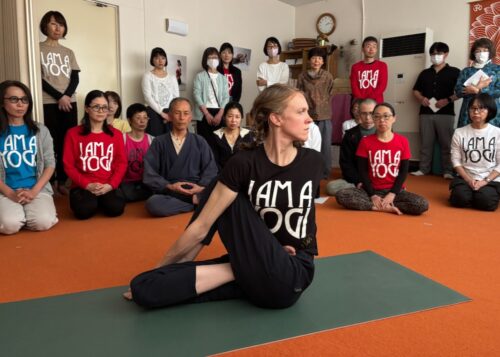
Drawing Inspiration From Brother and Sister Disciples
Who Are Striving to Draw Closer to the Teachings of Yoga
Since my earliest memories, I remember having the tendency of becoming frustrated when I didn’t understand something. Not only that, my mind is always seeking for a quick answer, and the understanding has to be of the nature that I don’t have to revisit or think about it anymore. I’m also usually satisfied with an intellectual understanding and don’t make an effort to go through a process of discovery on my own. Probably, this has to do with my habit of tending to lose patience and give up quickly if I encounter something that I need to struggle with, or something that needs a lot of effort or might take a long time to learn or understand.
In May, Sadhya, our sister disciple in New York, did an asana demonstration, followed by Question & Answer, in Matsuyama, Japan, and the questions and answers were published in Pranavadipa Vol. 139 (Mahayogi Yoga Mission of New York’s monthly online publication).
Watching Sadhya practicing asana in the past, I’ve noticed her strong concentration, but I was sure there must be something more than that. As I read the questions and answers, I became excited because I thought I could get a glimpse into Sadhya’s inner world during her practice of asana, but I also sensed a feeling of frustration starting to build slowly within me as I was reading, which manifested itself in me reading these questions and answers faster and faster. After I finished reading, I was left with the uplifting feeling that came from sensing Sadhya’s effort and determination to deepen her practice, but I also saw a part of my mind being disappointed because I didn’t get a definite answer to what Sadhya’s experience was, or what she has realized during her asana practice. 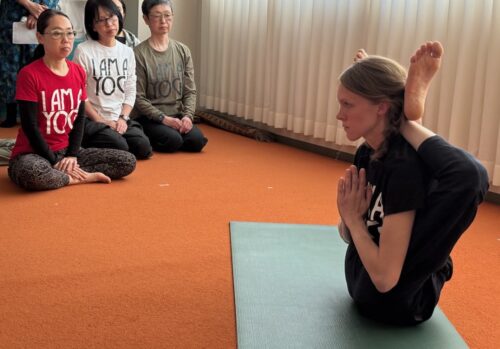
For example, in our practice of asana, while in most of the asana, the eye gaze should be pointed toward a certain direction; so when she was asked what she was seeing when her eyes gazed during an asana, she answered that she was not really seeing anything. Or when asked if her internal concentration happened naturally or if it started to happen gradually, her answer was that she doesn’t know exactly because she was not necessarily aware of it.
Another instruction during the practice of asana is to focus on the exhalation. Sadhya was following the instruction wholeheartedly, but again, in her answer, there was no mention of any experience as a result of her concentration, but rather, her answer was “even something as simple as the breath, the focus on the breath, I feel, is an internal focus.”
After reading through the Question & Answer a couple of times and looking more closely into Sadhya’s answers, even though my mind wasn’t getting the kind of answers it was looking for, I sensed that despite the fact that her concentration was intense during the asana, there was a kind of freedom in her practice.
Then I noticed that her answers were hinting towards the idea that an experience can be a result of a long process we put ourselves through, and not necessarily from a quick act with a certain result that the mind chases and expects while going through that process. And actually, the holding of a certain image of what the result should be seems to be blocking me, and probably many of us, from letting the real experience take place instead.
While reading, my mind was in a state of being tight or bound to an expectation or an idea, whereas her answers were pointing to the exact opposite: a mind that does not chase a certain result is free, or at ease, always ready to be used for the next step in the process. As I read, I looked back at my asana practice when I used to do it, and then, when comparing to her mind, I realized that my mind was in the exact opposite state. And, I saw that I read to try to get an answer quickly, instead of simply letting myself be inspired by her practice and the unknown that can possibly come at some point as a result of applying the same hard work and dedication; I also saw that, in this state, my concentration is weak and the mind is not at ease.
It seems that for any achievement one strives towards, what’s needed is a certain amount of passion, dedication and hard work, and the mind is definitely needed there as a tool. At some point, going against the habits of one’s own mind, which aren’t necessarily helping in the process, and at the same time building new positive habits, are things that also seem indispensable, especially when we are aiming for that which we’ve never experienced before. If the aim is the transformation of one’s own self, these qualities are even more urgent.
In today’s world, where we can get answers instantly to almost anything through the use of the internet, the tendency is to think that we know or we understand, and this can give our minds a quick feeling of satisfaction. But the danger is that, usually, in this case, the mind can only get an intellectual idea about the subject, and not have a deeper understanding based on an actual experience. And when we are put in the situation of having to practically explain or use our understanding in the real world, we almost always fall short and feel lost.
For me, one of the most intriguing things that Sadhya said a few times when answering was that she is trying to get “closer and closer.” Her words seem to indicate that she leaves herself open to the unknown, because presumably she tries to get close to a state of being, an experience that she has not experienced yet. It portrays and hints at an internal journey that no one can truly understand just by hearing or seeing the person who is experiencing it. How often can we truly say that we understood somebody else’s experience without having lived through it ourselves? Yet, her constant inspiration is from those who have reached a state of being that is even beyond the mind.
Shri Mahayogi teaches that the state beyond the mind is the natural state of human beings, which is a state of complete peace. There are probably not many who have devoted themselves fully to reach such a state, however, it is, in a way, a journey that most likely all of us will have to take, in one way or another, if we want to transform ourselves and reach our full potential. Those who have reached that state beyond the mind throughout the ages are proof that any of us can experience that too. Having the opportunity to meet someone in that state is extremely rare, and unless receiving the guidance from someone who is already in that state, it’s impossible to reach the realm beyond the mind. Have I, or any of us realized that? Only by devoting and giving ourselves completely can we say that we have.
Shri Mahayogi says that that state is already here and now. In order for me to start walking more concretely and get close, or rather, go closer and closer to that, I must accept that there is nowhere for me to rush off to or get to. I also need to accept that what stops me from experiencing it is precisely my mind’s belief that getting a quick answer or intellectual understanding will make me happy or at ease.
At this moment, all I can say is that the teachings of Yoga—which go far beyond the asana—and the examples of my brother and sister disciples, have been my only tools. Even though I can’t say that I understand the teachings or the examples of my brothers and sisters fully, they have at least helped me pause and notice the patterns in my mind I mentioned above.
Seeing Shri Mahayogi’s teachings that Sadhya is putting into action in the practice of asana is an inspiration and also a concrete example of what I can actually work on. Clearly, first and foremost, I need to build passion, the passion that has the strength to drive my mind constantly towards the need to transform; and I believe that this passion can come by continuing to study, think about, try to understand and incorporate the teachings into my real-life situations, while at the same time, being with and finding inspiration in the examples of my brother and sister disciples. And importantly, beyond mere intellectual understanding, I have to put the teachings into actual practice in order to truly understand them; so I will practice discriminating between the content of my mind regarding myself and the outer world, and the ultimate Truth, and then relinquish my false notions that are not rooted in the ultimate Truth. This is one of the practices of Yoga. Shri Mahayogi says that this is a constant battle, but just like with Sadhya’s strong concentration in the asana practice—which stems from her determination—it is something that I must determine and dedicate myself to, making space in my mind to allow for something that I never thought of to come in, without having any specific expectations. This way, hopefully, I, too, can inspire others to connect with and learn Shri Mahayogi’s teachings of Yoga.
Shri Mahayogi, I’ve started to recognize the necessity of actual practice more concretely than before, and I am so grateful for your giving me, and all of us, the opportunity to transform ourselves through Yoga!
Ekanta