
Thursday November 12nd, 2026
Through the Fabric of Sangha
In Japan and Taiwan, 2026
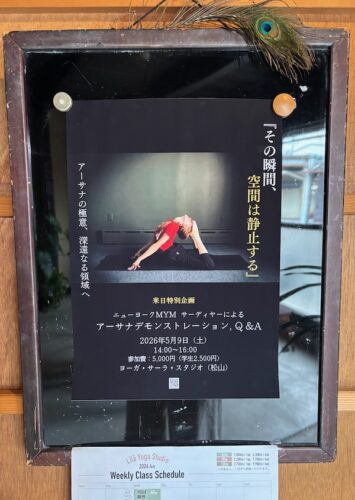
In May of 2026, I received the opportunity to travel to both Japan and Taiwan and spend some concentrated time with the gurubai (brother and sister disciples) in both locations. This opportunity came because I was invited to perform the part of demonstrating Shri Mahayogi’s asana in the Mahayogi Mission Taiwan’s production of Amrita, a 3-part event originally developed and performed in Japan in 2005. And, in considering the need for my body to adjust after a long flight and get over any jet lag prior the event, and also with Taiwan being so close to Japan, Anandamali suggested that we first go to Japan, before going to Taiwan—going to Japan, for us, is like making a pilgrimage, and it is also a cherished opportunity to be together with our brothers and sisters there.
View from the window of Prema Ashrama
For Japan, Anandamali carefully crafted a very rich experience that was quite different from the first time I had gone there—on that occasion, the time was centered around meeting with Shri Mahayogi, attending the Sanatana Dharma Avatara Mela, for which gurubai from all parts of Japan travel from where they live and gather in Kyoto, and having the opportunity to meet and spend time with some of the close and long-time disciples living in Kyoto City, who I had been hearing about for years and whose questions and testimonies I had been reading and learning from. This time, however, Anandamali initiated the arrangement of various opportunities to meet with and see different gurubai where they live in different areas of Japan. In part, the thinking behind it was that, in this way, I would have the opportunity to see how different gurubai live and practice in their respective environments, and, at the same time, I would be exposed to more of the country of Japan, to its people and its culture, which are all very different from the U.S. And, if I mention another aspect, Anandamali and I often talk about the importance of building a stronger bond of sangha, and she always emphasizes the necessity of establishing more and more strongly, throughout the Mission, the bond of sangha that spans across all borders of individual countries, across all regions, and across an ever-widening range of gurubai—so with that, too, in her mind, not wanting to miss any opportunity for that to develop and grow, Anandamali compactly and concentratedly organized our time in Japan, even setting into motion an additional asana demonstration organized by the gurubai in Matsuyama.
Sangha, as the community of practitioners, is one of the three treasures taught by Buddha, equal in preciousness to both the Buddha, or the Awakened Master, and the Dharma, or the Eternal Truth, and none of these three exist independently of the other—the Buddha, the Dharma and the Sangha are inextricably intertwined with one another. Throughout the time spent, both in Japan and in Taiwan, I couldn’t help but keep thinking about sangha. The fabric of Shri Mahayogi’s sangha and the importance of it—the interactions that came to transpire, the richness of the experiences, all of which were as if being woven from and into this fabric, have become a great stimulation and inspiration for me that seems to have shaped again the ground for the lessons of Shri Mahayogi to continue to unfold.
I was asked to share what I saw and experienced so that the inspiration and stimulation of sangha can expand beyond just a few people involved and continue to develop, grow, and feed our hearts to keep taking strides on the path of Yoga and find and fulfill our roles in the great Mission of Shri Mahayogi.
Part 1
Tamba-Sasayama: Action, Transformation and Devotion
A few days after my arrival in Japan, Anandamali and I accompanied Madhri on her once-a-month trip to the Tamba-Sasayama area, one of the countryside regions in the Kyoto prefecture where she leads a monthly Asana & Meditation class, to meet Ms. Fujiwara and Ms. Sono. As we rode on the train, the train’s path seemed to be cutting straight through the mountains. The steep yet gentle slopes towered on each side and were covered in a combination of fresh green leaves and patches of wild tree flowers. And looking down into the plunging gorges that suddenly opened below the train tracks, was the rushing Hozu River, swiftly making its way through the gorges with such tight bends that we passed over it multiple times in a short stretch.
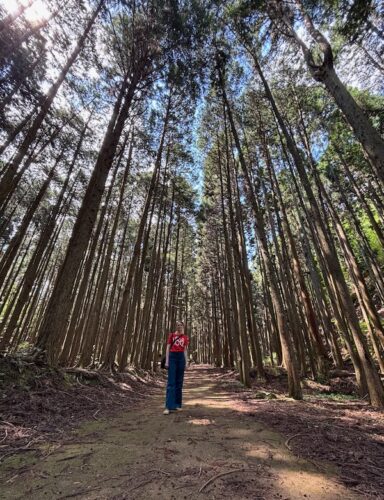 It was a dramatic introduction before the scene changed again, the mountains moved a little more to the sides, mellow waterways appeared, carefully directing water through the small towns, and we arrived at the destined train station. There we were met by two smiling and beaming faces, Ms. Fujiwara and Ms. Sono, who were kindly collecting the three of us to then go on towards the next destination—the area where the class was going to be held by Madhri. As we went further away from the train station and into the countryside, the scene started to change again—cedar forests stretched up the mountain sides, and I was amazed to see how the valleys were tightly organized with not a bit of wasted space between rice fields, other planted areas, cobble stone roads, and housing. There wasn’t a single field, patch of land or even a drainage ditch that didn’t seem to be cared for and well-tended.
I was aware that when Anandamali had made the request for us to go to the Tamba-Sasayama area, it was not to attend or observe the class, but it was to have the chance to make a connection with and get to know Ms. Fujiwara and Ms. Sono in their home area. As far as I knew, both ladies had arranged their schedules, which are busy with family life and activities for the Mama Yoga Lila group (the Yoga group operating in the area and named by Shri Mahayogi), to spend time sharing a meal together at a café where we could speak and get to know one another. But, as we rode along briskly in Sono’s car, the conversation seemed to be developing rapidly, and before long, at Anandamali’s request, it seemed as if the day was also very likely going to include an impromptu kirtan later on, and a visit with Ms. Sono’s friend from the U.S., Anna, who lives in the area and sometimes attends the Mama Yoga Lila kirtan program.
I had already heard from Anandamali that, when attending the kirtan program in Kyoto recently, which was being led in part by Ms. Sono, what she had felt from Ms. Sono and her singing kirtan, was something like an all-embracing, loving personality, reminiscent of Mother Earth, and I knew that Anandamali had wanted me to have the chance to experience it too, if possible, as well as Ms. Fujiwara’s drumming accompaniment. So, through Anandamali’s quick action and always working to make the most of each moment and opportunity, spontaneous arrangements were indeed underway for us all to visit Anna later on, and for the kirtan spot to possibly be there, at Anna’s place. As it turns out, Anna has been living in Japan for many years, has family and runs a home school program that she began for children of the area. And, quite to my surprise, she is actually from the same state as me, North Carolina, just a couple of small towns over from where I grew up…a highly unusual coincidence!
Whether from the ride and conversation in the car from the train station, to the layout of the land and housing, to later as we stopped by Ms. Fujiwara’s family home on the way to the café after joining Madhri after the class, with it being my first time visiting the countryside in Japan and catching a glimpse of the way of living, I couldn’t help but get the sense that everyday life in the countryside is centered around family life. The houses that we passed here and there were flying koinobori (carp flags), which I had just learned from Shantimayi the day before when we visited the Ashrama are a traditional symbol of celebration that the household has sons and a wish for those sons to grow up healthy and strong. And as we arrived at our destination, which was a café inside of a family home, from the layout of the space to the staff that seemed to span a couple of family generations, the whole atmosphere was very homey. And there, in the sunny garden area, surrounded by spring greens and flowers, and with one course after the next being placed on the table, each with as much fresh variety, beautiful presentation and delicate taste as the next, our conversation began to unfold.
*
Before meeting Ms. Fujiwara and Ms. Sono, I didn’t know much about them. I had only heard the message Ms. Fujiwara offered on the occasion of Sanatana Dharma Avatara Mela a couple of years ago, and I recently had heard that Ms. Sono had begun to involve in leading Bhakti Sangham for the first time a few weeks earlier. But in spending time with them, I could feel that both are fueled by their own devotion and passion towards Shri Mahayogi and Yoga, and that together they are continuing and leading the activities of the Mama Yoga Lila group. Ms. Fujiwara is leading the ongoing Asana and Meditation class for mothers in the area, and Ms. Sono is leading the Tamba-Sasayama kirtan program, with Ms. Fujiwara accompanying her on the drum.
While at the café, Ms. Sono was bubbling over with energy and warmth and enthusiastically talking about kirtan, and actually, I couldn’t help but notice that that had been the case even from the moment we met at the train station.
It was quite surprising to learn from her that before becoming involved in kirtan, she was very much lacking confidence in herself and all the time plagued with a sense of insecurity, so much so that she expressed having difficulty dealing with day-to-day life and had become rather depressed, not knowing what to do. Now, there does not even seem to be a detectable shadow of that persona that she described as dominating her before, and rather, her joy and enthusiasm around kirtan seem to be occupying her spirit constantly. We heard that everywhere she goes kirtan is happening, and emphatically says that continuous kirtan can resolve the problems one is facing. Any time and any place is a good time and place. Her faith and unwavering belief in the certainty of that are contagious, and I can only imagine that that is shining forth through her because of experiencing the real transformation of her own life. Though, as Ms. Fujiwara pointed out, for many people continuous kirtan may not seem to be very easy or practical, but Ms. Sono’s own action on that and her feeling of certainty about it made it feel 100% doable. Even her own mother has been drawn by that spirit and now participates in kirtan alongside her every single day.
Comparatively speaking, Ms. Fujiwara was measured, grounded, and when speaking about her journey of starting to become involved in the activities of Yoga, her strong faith seemed to bring weight to each of her words. Ms. Fujiwara shared very matter-of-factly and straightforwardly about her own journey, how she became involved in what is now the Mama Yoga Lila group and her role at this time. Through Ms. Fujiwara, for the first time, I learned about how the teaching of Shri Mahayogi came to that area, and how the seeds were planted and were made to start sprouting, which I would like to introduce.
Yoga is Practical: Experience and Everyday Life
There was a disciple of Shri Mahayogi, Saranya, who established an organization to support new mothers and babies centering around baby massage. She seemed to be a very proactive woman with a pioneering spirit. Actually, I have heard about Saranya for years, about how amazing she is with children and how active she was in the world of mothers and babies, and that through her and the organizations she began, many mothers were helped. But what I hadn’t heard about was how she introduced Yoga and how she came to involve others in Yoga and, in her own way, spread Shri Mahayogi’s teachings. As it turns out, both Ms. Fujiwara and Ms. Sono came to learn of Shri Mahayogi and his teaching through the activity and introduction of Saranya.
I learned from Ms. Fujiwara that although Saranya was very actively and enthusiastically introducing the teachings of Yoga that she was learning from Shri Mahayogi, she actually didn’t really talk about Yoga, use the language of Yoga or say anything about “teachings of Yoga” or Shri Mahayogi when interacting with the general public. She used common everyday language to introduce practical ways of living and dealing with common everyday family life, which were based in the Yoga she was learning from Shri Mahayogi, and that really became a big help to the people who were receiving it. And through that, whether or not people knew those things were coming from or had their base in the teachings of Yoga, I imagine they had the opportunity to experience for themselves some important and impactful difference.
Experience—I think that “experience” here is one of the important points and something that Shri Mahayogi often emphasizes, that it is important for someone who is being introduced to Yoga or who doesn’t know Yoga to “experience.” From what I understand, the reason is that oftentimes we are completely dwelling in our own mind-worlds, and seeing anything beyond that may be very difficult, may not make much sense or may not seem to be valuable, however, by experiencing something different through our senses, then that can open up the mind that can’t see beyond its own world, to something new—and that, I think, is where Yoga, along with all the benefits it can bring, is…beyond the mind. Therefore, experience, or the continuation of experiencing, that allows the boundaries of the mind to be pushed, is also equally important for one who is already learning or walking on the path of Yoga. But experience first requires action—Shri Mahayogi often recommends for someone unfamiliar with Yoga to attend the Asana & Meditation class as one means of taking an action that will allow “experiencing” to happen. But in the example of Saranya, dealing with practical daily life matters requires constant action naturally, so doing so in a way that has the teachings of Yoga at the base, must certainly be another means of allowing “experiencing” to happen.
Hearing about Saranya, I felt that hers is truly a great example, and I felt so grateful to be able to hear about it. Not only for creating the opportunity to experience the benefit of Yoga through action, but also for being able to introduce and share the teachings of Yoga with so many people throughout Japan without using any special language or “teachings.” Sharing Yoga with others is indeed a wonderful thing and I’m sure many of us who have been touched by Shri Mahayogi’s Existence or his teaching must also want to share it with many people. If I think about it, for Saranya to bring the teachings of Yoga to the hearts of many people without even mentioning about Yoga must mean that Saranya was able to digest the teachings of Yoga in a way to make them simple and practical for everyday life and the real everyday situations people are facing, especially in that important transition into family life that must bring about so many new situations. The words and teachings were not living on a page or remaining in a lofty idealistic thought, they were translated into simple, actionable means. And I imagine that the ability to do that comes through making a real connection between what one hears in the teachings and what it might mean or look like given one’s real experience of life.
Shri Mahayogi always says that Yoga is practical and not something that we do or practice for a certain part of the day or something that we recite or just imagine, but it is about the way we live every moment, the way we see and deal with the people and situations around us and what we choose to place as the base of our actions. Yoga lives in the scenes of everyday life.
I never personally had the opportunity to know Saranya, but I would suppose that she attempted to share what she was learning from Shri Mahayogi because she experienced the real value of that for herself in her everyday life practical matters. So hearing about it, I felt that I received a very important example to follow. If I reflect on myself, how much have I developed this ability of bringing the teaching of Yoga to a very practical level? I think it’s a part I need to continually work to develop within myself.
Action and Devotion
I asked Ms. Fujiwara how it happened that she ended up meeting Shri Mahayogi, especially if Saranya wasn’t necessarily speaking about Yoga or Shri Mahayogi. Then she explained that, actually, Saranya gathered some members of the group who she felt were more serious, and then started to introduce more directly about Yoga and Shri Mahayogi, and that’s how it began. She mentioned that it seemed that one of the things Saranya was always doing was intentionally trying to create and establish sangha, no matter where she went, thinking that, no matter where it may be, it’s important to have sangha. So, Ms. Fujiwara and Ms. Sono were among those who were gathered. In Saranya’s enthusiasm for establishing sangha, it seems she also created a flourish of activity wherever she went and involved others in many activities, effectively putting them to take action around Yoga whether they volunteered themselves for it or not—and that flourish of activity seems like it could come like a whirlwind, and sometimes may have been quite tough to work in.
Ms. Fujiwara was one of the people that Saranya was involving in that flourish of activity around Yoga, and she spoke frankly that for a long time she struggled with that relationship, as she herself felt frustration and sometimes anger about the situations that would arise, not necessarily agreeing or seeing eye-to-eye with Saranya when in the whirlwind of that activity. She characterized herself as more rebellious, whereas she characterized Ms. Sono as always simply following Saranya and being more easy-going about being involved in these things. Ms. Fujiwara spoke that, though her emotion appeared in this relationship, because she had met Shri Mahayogi and was applying the teachings in her daily life, she gradually recognized that that emotion was coming from a lack within herself having to do with not easily letting go of her own ideas of how she thinks things should be, what would be best, etc. Now, however, after seeking and continuing to follow the guidance of Shri Mahayogi, that part within her finally came to be resolved.
I was impressed with how honestly and sincerely Ms. Fujiwara spoke about her own struggle, and how much she trained and worked on herself. Surely everyone can look within themselves and see a time or two—or many!—in which flashing emotions arose in the mind in a challenging relationship. It’s a common mechanism of the mind, but perhaps what may be less common, is for that to prompt us to look for a lack within our own selves, and then work to change it, like in the case of Ms. Fujiwara.
I would imagine that having already been introduced to Yoga and to Shri Mahayogi’s teaching, was a great influence on how Ms. Fujiwara dealt with or faced the challenge she was experiencing, not to mention the clarity of trust she placed in Shri Mahayogi and her willingness and want to be guided on the path of Yoga. At the same time, though I truly don’t know any detail about the scenes or activities that were unfolding in those sangha groups initiated by Saranya, whether fruitful as per the original intention or not, or whether they came to be completed or not, I can’t help but think that the fact itself of being thrown into constant action was an important condition. Though perhaps difficult, as she expressed, the intensity of those scenes of action with Yoga at the center surely brought about situation after situation that pushed the tendency of the mind to the forefront to such a degree that it could not be easily ignored or escaped. Or, perhaps more precisely speaking, while learning Yoga and really trying to mold oneself on the guidance of Shri Mahayogi, ignoring or escaping just isn’t an option one can accept anymore.
Ms. Fujiwara’s constant reflection and application of the teachings of Yoga came to be the next action, which she seemed to do devotedly, over and over again. Whatever it may be, Shri Mahayogi always emphasizes that action is an essential component of our learning and growth in Yoga, and probably that is the same for just about anything we try to learn or aspire to. But, particularly when action has Yoga at the base or is coming from the spirit of sharing Yoga with others so they too can receive its immense blessings, that seems to be an important ground that holds the opportunity for our transformation and deepening on the path of Yoga.
*
As time passed at the café, and the final coffee and tea was served, Ms. Sono began to stir us all towards making a move onto the next destination, saying that, “there is still time for kirtan!”
We left in two cars, Ms. Sono and Madhri in one car and Ms. Fujiwara, Anandamali and me in the other. In the short drive that took us along precise 90 degree turns on the narrow roads between rice fields and up the mountain, suddenly Anandamali expressed to Ms. Fujiwara, “Wow, you are like a completely different person!” Anandamali was referring to Ms. Fujiwara’s personality, which, after getting in the car, seemed to have transformed from the more reserved and serious nature we saw when we were at the café with Ms. Sono. During that time, both Madhri and Ms. Sono had even commented that the combination of Ms. Sono and Ms. Fujiwara’s personalities was such a great combination for heading the activities of the Mama Yoga Lila group, because Ms. Sono was full of emotion and very outgoing, whereas Ms. Fujiwara was very grounded, rational and seemed to be keeping everything organized—both are very important aspects for different reasons. Upon hearing it, while laughing, Ms. Fujiwara started to say that her natural way of being is more like how she is now, and that what we perceived at the café is not really the way she is, but because Ms. Sono is so full of emotion and passion, then it seems that that condition naturally requires her to always balance out that aspect by herself being very practical, organized and thinking through everything very realistically as they manage the Mama Yoga Lila group and its activities. Indeed, the situation itself seems to demand that Ms. Fujiwara develop a part of herself and play a role that she may not see as being what comes most naturally to her.
Hearing it and reflecting for myself, this need to “develop” or “be” a certain way that’s not necessarily one’s common way or habit through the dynamic of sangha is something that I certainly see in my own experience and in sangha around me, and I couldn’t help but think: How fascinating sangha is! How amazing the way the Guru, Shri Mahayogi, is constantly working and providing for our growth in Yoga is! It really seems that Shri Mahayogi is working through the body of sangha itself to develop his disciples variously according to what’s needed.
There is a famous teaching from Shri Ramakrishna comparing sangha to washing potatoes in a pot, the potatoes rub against each other and in that way become clean and purified much faster—which, this case doesn’t seem to be exactly that, but rather, if going forward with the metaphor a little, as the potatoes become a little cleaner, next comes thinking about how to prepare those potatoes to be used for the proper dish…or in our case, how we ourselves come to be prepared for becoming the best instruments possible to be used in the greater Mission of Shri Mahayogi. When it comes to things we need to develop in ourselves or things we lack, we may not be able to see or have the bigger picture view to identify or think of and address these things on our own, but surely through involving with sangha, and if our aim is truly aligned with that, I believe that our opportunities to develop the parts of ourselves, our character or our skills that are either undeveloped or lacking, surely will be brought about.
A yogi must be ready for anything—around the time I was first starting to learn Yoga under Shri Mahayogi’s guidance, I heard that Shri Mahayogi said something to this effect. It had a strong impact on me at that time and I continue to bear it in mind. I think that Shri Mahayogi is very much alive and working through sangha—helping us develop whatever is needed so that we can be ready for anything. Because when it comes to the way we already are, what we’re good at, what we’re not, etc., etc.…these things really don’t hold much relevance—whatever is required to pick up and carry the Mission of Shri Mahayogi forward, is what’s required, and I think that’s what we must be ready for and fulfill.
Manasa Bhajare Guru Charanam, Dustara Bhava Sagara Taranam
“O Mind, worship the lotus feet of the Guru to cross the ocean of life”
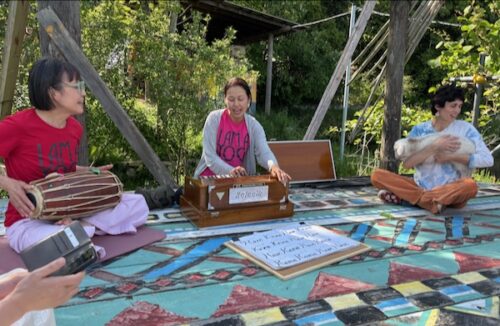 Climbing up onto a colorful wooden platform called “the theater” in the midst of an open field after having arrived at the home and school grounds of Ms. Sono’s friend, Anna, and with the sun shining in the fresh mountain air, the kirtan began. With Ms. Sono leading us on the harmonium, with Ms. Fujiwara accompanying on the drum, and with Anna, her mother, who happened to be visiting from the U.S., and one of Anna’s children gathered with us, including an adopted lamb, the songs in praise of the Guru, of Shiva, and of Shri Rama and Shri Krishna filled the air.
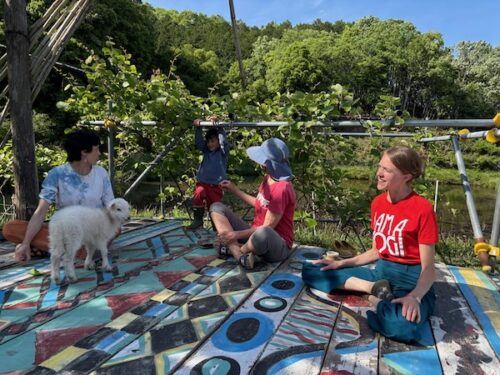 My heart was full. I was rather lucky to be able to experience the Tamba-Sasayama kirtan, so down to earth, yet full of devotion, and in such a location where it seemed as if the leaves, the flowers, the grass, the animals, the trees, the mountain and the wind were all glistening and shining with the vibration of the praise of the names of God. And to be able to be there in Tamba-Sasayama with the gurubai whose hearts are full of passion for Shri Mahayogi, for Yoga, for God, was a blessing that I think can only come about through the grace of the Guru.
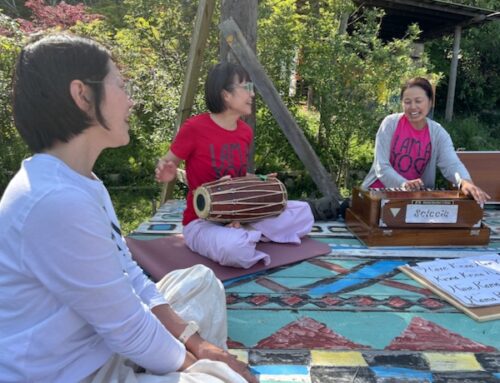 The fact that Anandamali arranged an opportunity to venture beyond the center of Kyoto on this occasion, felt to me like an important message—the hearts that Shri Mahayogi has touched and painted with the color of Truth are sprinkled in many different places, and the passion ignited in those hearts and how it is moving and growing in different environments and circumstances is one of the means through which Shri Mahayogi is teaching us. Especially now, when the familiar form of Shri Mahayogi is not right before us, I feel that he is showing us his many faces and aspects through the gurubai in different places. And, if we open our eyes and look there with an open heart, there is much to learn. That, I feel, is a great inspiration and testament to the greatness and vastness of Shri Mahayogi.
-Sadhya