
Saturday October 3rd, 2026
What Shri Mahayogi Teaches Can Only Be For the Better
—To Exhale Long and Complete Or To Think About “Me”?
I’ve heard the words, “long and complete exhalation” many, many times and believed that I was following it to a good extent—sometimes more consciously and other times more mindlessly. But up to recently, I had not felt a strong motivation to explore the depth of the instruction that Shri Mahayogi emphasizes so much. It all began with a persistent pain in my left knee.
“What Shri Mahayogi teaches can only be for the better.” I found myself repeating this in my mind when I realized that what was once a slight discomfort in my left knee had become an ongoing pain that had lasted over four months already. At some point toward the end of the Spring, the pain intensified and it also appeared in my left hip. It became uncomfortable to walk, sit, climb stairs, to bend down, and even to lay down to sleep.
As a primary schoolteacher I have to be on my feet all day, caring for and teaching young, energetic children, so I started to think that if my knee did not heal, I would have to change careers and my whole life, including my 4th floor apartment in a walk-up building. What’s more, my ability to live in New York City could also be at stake. “How would I manage?!” My head would sometimes spin around thinking of these possibilities. I imagined changes and challenges coming at me all at once like a giant snowball. At times, the form of Shri Mahayogi would appear in my mind along with the thought—“What Shri Mahayogi teaches can only be for the better”—but I was not sure what to do exactly.
An orthopedist looked at an MRI of my knee and said that, although nothing looked damaged, I had probably developed a knee condition from “overpronation” (rolling my foot too much toward the inside), which had begun to overstretch a tendon in the knee causing pain to radiate out. The doctor recommended physical therapy (PT) to strengthen the muscles around the knee, train myself to step differently and avoid any further damage. After one month of PT in the summer, in fact, the muscles that support my knee began to get stronger and I was able to step more confidently and with less discomfort, but the condition had not really healed and the pain persisted. I had one more month of summer before having to go back to work.
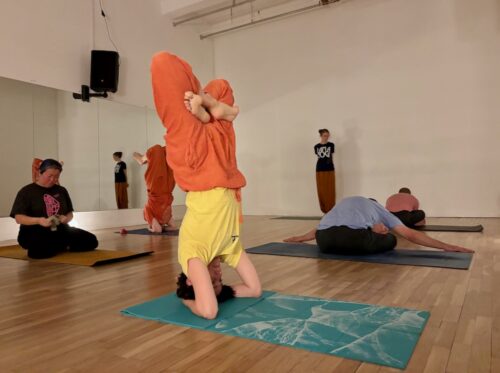
Throughout this whole period of time, I continued practicing asana pretty regularly as I’d been doing for quite a long time, although, I was not sure if it would help me heal or make things worse. Often right before practicing asana, the thought, “What Shri Mahayogi teaches can only be for the better” would pop-up again. I could not imagine that anything coming from Shri Mahayogi could do any harm—on the contrary—it could only be for the better. I wanted to put my trust in Shri Mahayogi, however, within myself, I had doubts of how realistic my own thinking was. To be honest, I was hoping that physical therapy would help me heal enough so that I could keep my job, manage my daily activities, like grocery shopping, riding the train, going up and down stairs, and also continuing to practice asana. More than anything, I was hoping that my life would not change or become more difficult.
For many years, I’ve thought of asana as the medicine for my body and my mind. My experience many times over has been that asana leads the body and the mind to a more steady and quiet condition in which one feels that there is nothing to complain about. In my opinion, this state is far superior to when one is happy, excited, emotionally satisfied, or positively stimulated in any way, because it is the only time that there is a very noticeable decrease in thoughts. Those are the only times in my life that I can say that I am truly at ease, when neither the body nor the mind express much at all, and they just seem to exist and function without creating any disturbance. Even though how asana works is still mysterious to me, I am certain that it balances and repairs the whole system at a very profound level.
Anytime I’ve had any medical condition in the past, physical or emotional, I’ve continued practicing asana at the same rate as before or maybe more. This time it was no different, except that I had the sense that because of my older age, this particular condition could end up being chronic, and I’d just have to learn to accept the pain as a natural part of aging. The thought of giving up asana, my medicine, was concerning, but while I grappled with the pain and the wanting to trust Shri Mahayogi, I started to recognize something that seemed more concerning still: “Maybe I have a strong attachment to asana as a way of physical healing. Maybe I am too concerned for my body and my mind. Maybe I really do think that this body and this mind are all there is to ‘me’?!” I was trying to be honest with myself and also to guide my thoughts rationally: “Shri Mahayogi says that anyone, in any condition, can learn and practice Yoga, and that asana is a means, not the end, so I should not be concerned if I cannot practice asana anymore.” No matter how I guided my mind, there seemed to be a sense underneath it all that kept me wanting the safety that asana makes me feel.
But, in the end, while juggling these kinds of thoughts, I decided that if I was still able to use my body to practice asana, I should be thankful for the benefits it brings and simply focus on practicing without overcomplicating things. But because there was still pain in my knee throughout the day and the night, I chose to practice some simple variations of the poses that I normally practice and avoid any extreme bending of the knee. I continued, nonetheless, to practice all of the poses for the same amount of time as before—no other difference.
At first, it was difficult to differentiate between the effects of PT and asana. But after a month or so, the difference started to become clearer to me: physical therapy strengthened specific leg muscles and supported the injured areas all along the lower back and the leg. Thanks to that, my steps became more confident. Asana, on the other hand, seemed to be throughout the entire body and supporting the entire system from deep within, not in just one area or spot. The effect of asana was much more expansive; it would be difficult to define the limit of its effects. As opposed to tightening a specific part of the body, asana was doing the opposite and much more, it was taking away tension and tightness throughout the entire body, even beyond the physical body.
Shri Mahayogi explains that prana (ki or life force) flows through the nadi (hollow canals), and that the effect of asana on the prana, mind and body is impossible to detect with modern medical technology because it works at such highly subtle levels. I am aware that when practiced correctly, asana calms the mind and brings an overall sense of wellness and lightness, but during this time, when trying to find out if asana would help or hurt my knee, what I was surprised to notice so clearly within myself was the contrast between physical exercise and asana.
For two months in the summer, while wanting so much for my knee to heal and also pondering, “What Shri Mahayogi teaches can only be for the better,” the topic of the breathing during asana, which I had heard so many times in the past, started to sound more important to my mind when I heard about it during Asana and Meditation classes and in the conversations at Sangha meetings on the weekends. “Exhale long and complete, this is very important”—I heard, and “there needs to be a switch from focusing on inhalation to focusing on the exhalation”—I read in our blog, Project Sahasrara. At around that time, I re-read the testimonies in Pranavadipa Vol. 139 and Vol. 140 that Anandamali decided to publish in June and July. Both contained Sadhya’s words from a Q&A in Matsuyama, Japan, and in Taipei, Taiwan, which had taken place in May this year when Sadhya did an asana demonstration in those locations. Sadhya’s answer to a question about the meaning of “internal focus” during asana made me reflect. She said, “I felt that there is nothing, or I am so small that I can’t offer anything to God—but in asana, we are asked to exhale, to exhale long and complete, so even though the exhalation, which I felt at that time was the impurity of the breath, I thought that at least I can offer that more and more and more.” At first, I thought that her words about exhaling as a way of offering something to God sounded like a philosophical or devotional act, but then I began to think that what Sadhya was doing also seemed like a very concrete way of not taking for oneself what one does not need, as in the yama trainings in Yoga: asteya (non-stealing), or aparigraha (not taking greedily what one does not need).
After sensing the level of Sadhya’s thinking about the breath, I was moved to try to exhale more and more during asana, and gradually, without realizing it, something began to change. I started to think less about my knee and to feel less and less discomfort and concern about it. My attention kept being brought back toward the exhalation, because I wanted to find out what it could mean to really follow that instruction.
One day, when hearing the instruction “long, complete exhalation” in class, I put more intention to exhale longer, “beyond my limit,” and at that moment, my mind experienced strong discomfort and became angry. Sensing this reaction in myself, I realized that my “long and complete exhalation” was being limited, on the one hand, by the wish to breathe in, and on the other, deeper within, by my own attachment to the physical and mental well-being that I want from asana. I felt that my approach was completely opposite from what Sadhya had expressed in the Q&A.
After that class, I was a bit surprised and disappointed in myself, but later, I started to feel the need to change the state of my mind and the wanting to go past the limit that my own mind is imposing on the exhalation. Whenever I practiced asana, I began to realize that for so long, I’ve been believing that I am exhaling long and complete to the best of my ability, but the fact is that even if my exhalation is longer, my mind has kept holding on to a strong focus on “me” and wanting “for me.” This ongoing sense of “me”—which I started to be able to observe—is always swimming around in my mind like a hungry fish in a pond. I didn’t consider this state was a problem before, but during these days, the more I tried to exhale “long and complete,” the more I became aware of the “me” lurking around in my mind: “I am exhaling. I am doing this asana. I am moving this way or that way. I am gazing at this object… I, I, I…” Many thoughts, one after another, can get mixed up in the process of exhaling long and complete, simple ones or complicated ones. Noticing these things created an additional frustration: “Why can’t the act of exhaling be clean, simple and humble!?” While exhaling, I saw how my mind was acting as the narrator and commentator of its own thoughts, feelings and actions, as if projecting itself onto itself and onto the world! I was amazed and shocked! The next realization was equally uncomfortable. At all other times of the day, outside of asana practice, my mind is also constantly dragged around in exactly the same way by these thoughts, one after the other. I thought, “How can I possibly attend to any task or care for any person in this condition? How can I act to complete a task simply and straightforwardly if my mind is always trying to steal the attention for itself!!?”
Shri Mahayogi says in “Bhakti Yoga and Karma Yoga” in The Universal Gospel of Yoga that, “The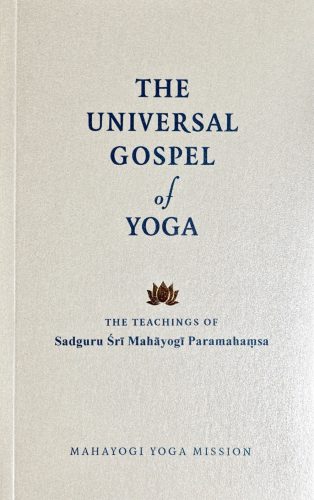 mind, which is abstract matter, is permeated with thoughts and sanskara from the past, or memories. It is like a cloud. It appears as if it were matter with form. But just like a cloud dissolves, the thoughts and sanskara will dissolve too. Originally, it must have been transparent to begin with, so they will eventually have to disappear. The proof of this is that the mind’s thoughts and the world are constantly changing, aren’t they? It is the same with clouds: the shapes and colors are always different. But the condition, the cloud, is always there. So that is what you must clear away.”
While trying to make sense out of what my mind does and how I could go about “clearing away” those recurring clouds of thoughts, I remembered these words of Shri Mahayogi and read them again. Even the idea of having pain in the knee, is a thought traveling through my mind, and all those predictions about the terrible or wonderful future as well! Even the belief that I have the ability to do an asana or not is the same! All of these are thoughts, clouds floating around, without any permanence! When I decided to try to focus on the “long, complete exhalation” more and more and pay less attention to my mind and its self-concerned thoughts, the pain would disappear during and after asana, for longer and longer periods of time. Not only that, since one of the effects of asana that I feel is that it heals the entire system, its visible and its invisible parts, without me realizing it, my knee had been healing as well.
It is now Fall and I’ve started teaching in school again. The concern about my knee has truly taken a back seat. During asana, while working on the “long and complete exhalation,” regardless of the tightness of the pose, my body is able to relax or “settle” into the pose more deeply, as if giving in to it. I believe this “settling into the pose” is brought about by the “long and complete exhalation,” as it continues breath after breath. This may be what opens up the space that is always filled up with thoughts of “me.” As I’ve kept trying, paying less attention to what my mind or body are saying during asana, I am beginning to experience how the focus on the “long and complete exhalation” weaves all the asana together from beginning to end, making it so that the mind becomes calm and stays calm for much longer after the practice. When this happens, I notice that it is easier to listen, think and consider situations and people more attentively and in a more efficient way.
I stopped PT over a month ago and decided to trust asana no matter how my knee or any part of my body feels. Now, the knee pain has dissipated almost entirely, so I can work, sleep, walk better and go up and down stairs without discomfort. I feel grateful to Shri Mahayogi for that, but still, I believe Shri Mahayogi is happier to know that I am finally beginning to understand why he puts so much emphasis on the “long and complete exhalation,” and that I am trying to follow his instruction much more. Through this whole experience, I have also been able to declare to myself that, “I want to be free from the idea of ‘me’ and ‘for me’ that takes ahold of my mind.” No matter my physical ability or condition for asana, one breath at a time, I want to work on letting go of “me,” and in daily situations, I want to redirect my mind away from the same “me”-centered thoughts and devote my attention to the one who is in front of me. The way to do that was there all along: “What Shri Mahayogi teaches can only be for the better.”
-Karuna